
Astronomers Capture First Direct Image of Protoplanet Swirling in Gas
This digest was compiled by AI from multiple sources — links to the originals are below.
An international team led by Dr. Myriam Benisty of the Max Planck Institute for Astronomy has directly imaged protoplanet WISPIT 2b, about 430 light-years from Earth, using the ALMA observatory in Chile. The image reveals swirling gas around the planet, matching predictions from disk-planet interaction simulations. The study, published in The Astrophysical Journal Letters, also confirms a companion protoplanet, WISPIT 2c, which has carved a cavity in the disk.
Key Facts
- WISPIT 2b is located about 430 light-years from Earth and is estimated to be about five times as massive as Jupiter.
- The protoplanet was directly imaged using the Atacama Large Millimeter/submillimeter Array (ALMA) observatory in northern Chile.
- A companion protoplanet, WISPIT 2c, orbits interior to WISPIT 2b at 15 astronomical units and is estimated to be 8 to 12 Jupiter masses.
- WISPIT 2b's discovery was announced in August 2025, and WISPIT 2c's discovery was announced in March 2026.
- The study was published in The Astrophysical Journal Letters and led by Dr. Myriam Benisty, Director of the Max Planck Institute for Astronomy in Germany.
Direct Imaging Breakthrough
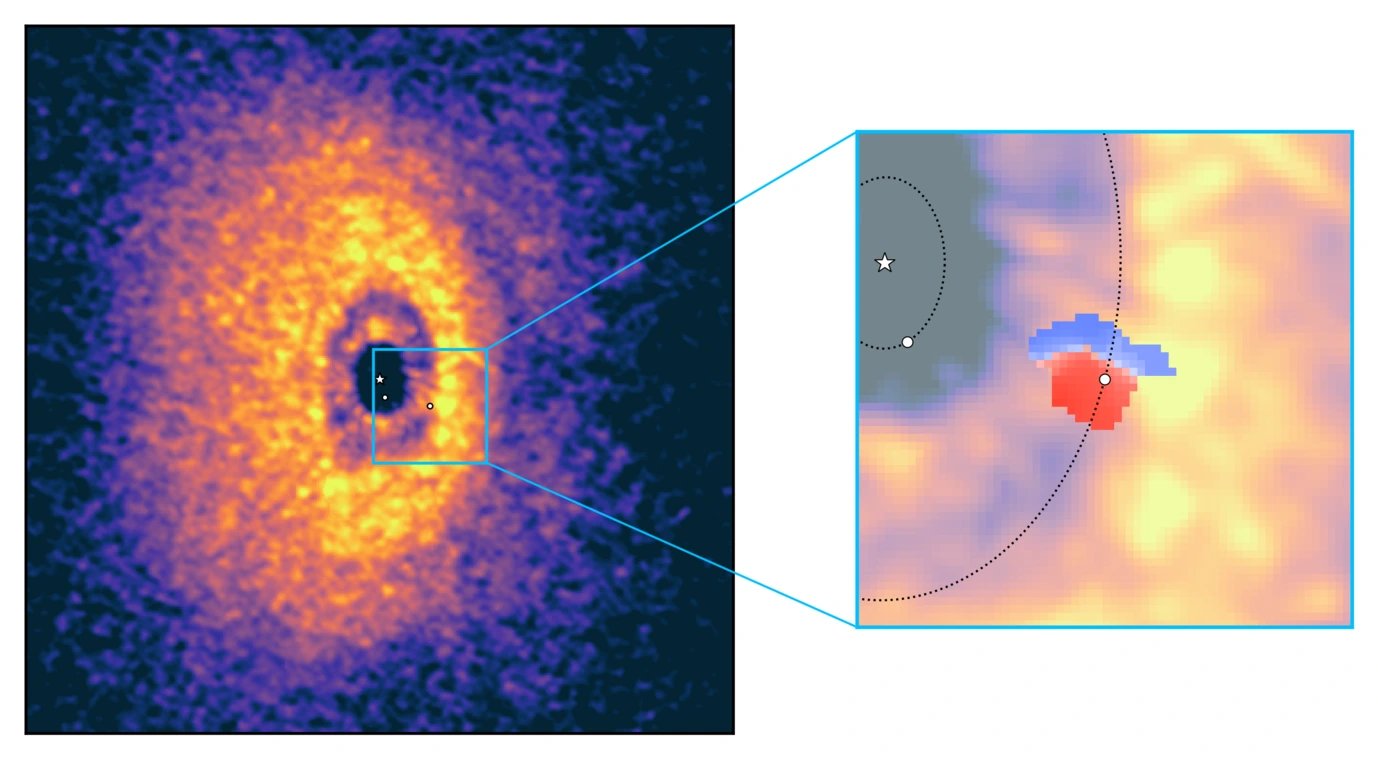
Researchers have obtained the first direct image of a protoplanet swirling in a ball of gas and dust, a milestone in planetary formation studies. The image of WISPIT 2b was captured with the ALMA observatory in northern Chile. WISPIT 2b is located about 57 astronomical units from its host star and is estimated to be five times as massive as Jupiter. The image shows blue and red regions indicating gas moving toward and away from Earth, respectively.
Disk Structures and Companion
WISPIT 2c, a companion protoplanet, orbits interior to WISPIT 2b at 15 astronomical units and has carved a cavity in the protoplanetary disk. WISPIT 2b has created a gap, a region of decreased disk material where the protoplanet continues to accrete gas and dust. Dr. Myriam Benisty, lead author of the study, stated that both planets are shaping their environment, with swirls of gas around WISPIT 2b matching predictions from simulations. The discovery of WISPIT 2b was announced in August 2025, followed by WISPIT 2c in March 2026.
1 source
Time · lag behind first