
James Webb Telescope Finds Evidence of Massive Planetary Collisions in Young Star Systems
This digest was compiled by AI from multiple sources — links to the originals are below.
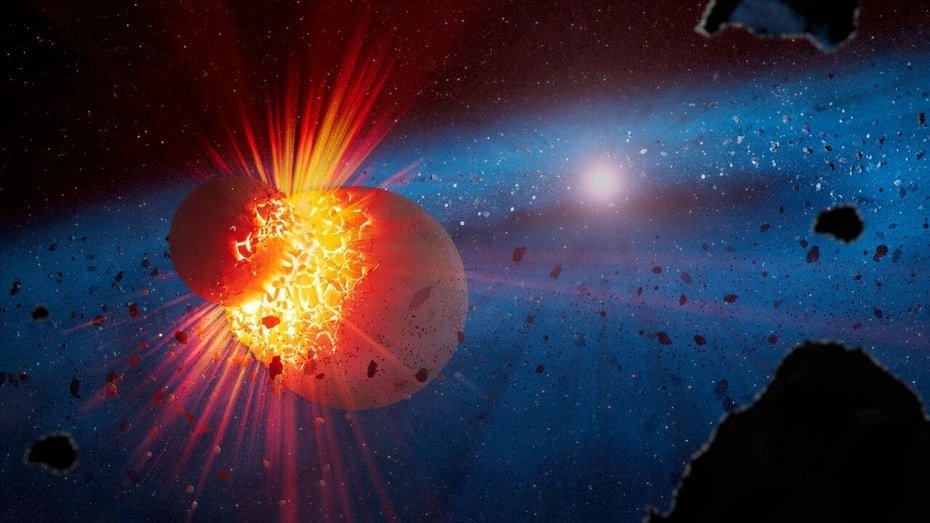
The James Webb Space Telescope has documented concrete traces of massive destructive collisions in young star systems. Astronomers analyzed 21 extreme debris disks, publishing results in The Astrophysical Journal. The findings define a new subclass of systems distinct from classic disks like Vega and Fomalhaut.
Key Facts
- The study analyzed 21 extreme debris disks, with 16 observations from the James Webb Space Telescope and 5 from the retired Spitzer Space Telescope archives.
- Only about 1 percent of observed young stars show signatures of extreme debris disks, indicating a highly dynamic early phase.
- The research team was led by astronomer Kate Su from the Space Science Institute in Colorado.
- Extreme debris disks are characterized by unusually large amounts of warm dust in inner zones, corresponding to the distances of terrestrial planets in our solar system.
- The findings were published in The Astrophysical Journal.
Extreme Debris Disks
Astronomers investigated a special class of systems known as extreme debris disks, which exhibit unusually large amounts of warm dust in their inner zones. These inner zones correspond to the distances where terrestrial planets orbit in our solar system. Current estimates suggest only about 1 percent of observed young stars display such measurable signatures. The team, led by Kate Su from the Space Science Institute in Colorado, analyzed 21 of these extreme debris disks in detail.
Data and Classification
Of the analyzed systems, 16 observations came directly from the James Webb Space Telescope, while five datasets were obtained from the archives of the retired Spitzer Space Telescope. This broad data foundation allowed the subclass of extreme debris disks to be reliably defined for the first time and distinguished from known systems like Vega and Fomalhaut. Vega and Fomalhaut are stars with classic, much colder debris disks whose material is located far from the center and resembles the outer Kuiper Belt of our solar system. In direct contrast to the extreme disks studied, these classic disks lack warm dust in inner orbits, which primarily indicates fresh planetary collisions.
Mineralogical Composition
The astronomers confirmed three key properties shared by all these extreme systems: significantly smaller dust grains than classic disks, an extremely high concentration of warm dust, and completely irregular brightness fluctuations. Using mid-infrared spectroscopy, the studied systems were then divided into two specific mineralogical categories.
2 sources
Time · lag behind first