
ETH Zurich builds quantum chip storing data in sapphire acoustic vibrations
This digest was compiled by AI from multiple sources — links to the originals are below.
Physicists at ETH Zurich have developed a quantum chip that stores information in acoustic vibrations of sapphire, achieving a 10,000-fold size reduction compared to electromagnetic waves. The work, published in Science, demonstrates quantum memory with coherence times up to 368 microseconds. The chip successfully ran two key quantum algorithms, including a three-mode quantum Fourier transform.
Key Facts
- The chip uses a high-overtone bulk acoustic wave resonator (HBAR) on a sapphire crystal a few hundred micrometers thick.
- Acoustic waves at 5 GHz have wavelengths of a few micrometers, about 10,000 times shorter than electromagnetic waves of the same frequency.
- The phonon modes retain quantum states for 127–368 microseconds, 5–16 times longer than the transmon qubit's 23 microseconds.
- Single-mode quantum operation fidelity reached 94.95–95.50%, with data exchange losses averaging 1.71% per operation.
- The chip successfully ran a three-mode quantum Fourier transform and a period-finding algorithm.
Acoustic Memory Design
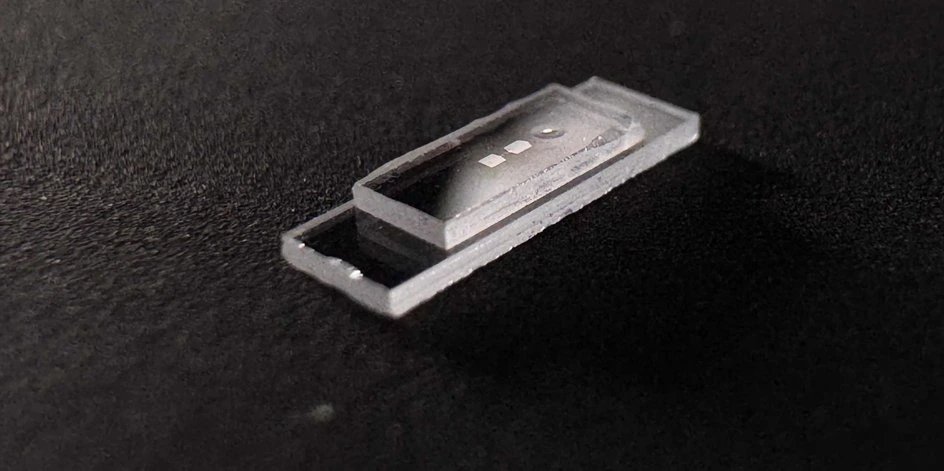
The chip stores quantum information in phonons—mechanical vibrations—rather than in electromagnetic resonators used in standard superconducting systems. It is built around a high-overtone bulk acoustic wave resonator (HBAR) on a sapphire crystal a few hundred micrometers thick. At the operating frequency of 5 GHz, acoustic waves compress to wavelengths of a few micrometers, while electromagnetic waves of the same frequency occupy centimeters. This four-order-of-magnitude difference allows thousands of acoustic memory cells to fit in a package measuring 7.5×2.5×1 mm, roughly the size of a fingernail.
Performance Metrics
The architecture separates roles: a superconducting transmon qubit acts as the processor, while the acoustic resonator serves as working memory. This separation improved coherence time—the interval during which the system maintains a quantum state. Phonon modes hold the state for 127–368 microseconds, 5–16 times longer than the transmon's approximately 23 microseconds. In tests, single-mode quantum operation fidelity was 94.95–95.50%, and data exchange losses between processor and memory averaged about 1.71% per operation. The chip successfully ran two key algorithms: a three-mode quantum Fourier transform and a period-finding algorithm.
Scaling Implications
Superconducting qubit quantum computers operate near absolute zero inside bulky cryostats. Fitting enough memory and computing blocks into their limited volume is a major engineering challenge. Compact acoustic memory directly reduces this burden and opens a path to scaling without proportional growth in equipment.
2 sources
Time · lag behind first