
Antwerp scientists find cable bacteria grow nickel-based conductive fibers
This digest was compiled by AI from multiple sources — links to the originals are below.
Researchers at the University of Antwerp have identified how cable bacteria build conductive fibers with nickel-based metal-organic frameworks. The bacteria produce these structures in water at room temperature, achieving conductivity up to 15,000 S/cm in individual nanoribbons. The discovery could enable flexible printed electronics using biological conductive inks.
Key Facts
- Cable bacteria conduct electricity over distances thousands of times their own cell length.
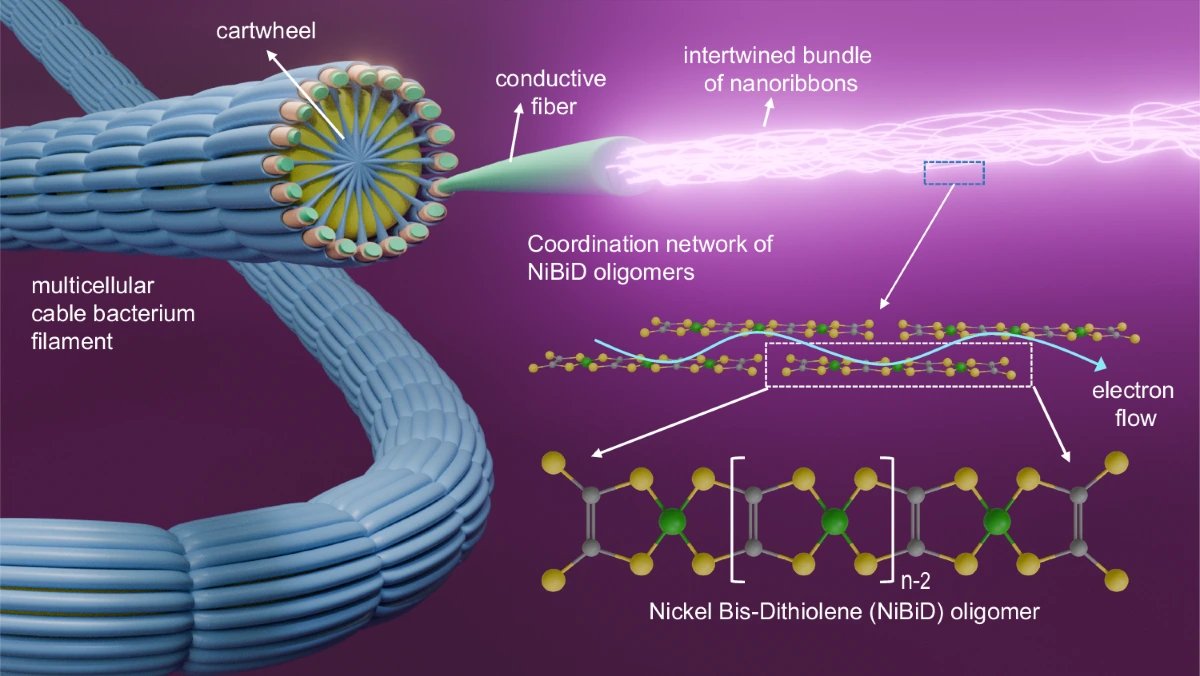
- Each conductive fiber contains about 11 nanoribbons, each roughly 1.4 nm thick, twisted like a multi-strand cable.
- The conductive core is a nickel-sulfur organic compound (NiBiD), a metal-organic framework previously considered only a laboratory material.
- Measured conductivity of individual nanoribbons ranges from 150 to 15,000 S/cm, compared to about 500 S/cm for whole bacterial fibers.
Conductive Fiber Structure
Cable bacteria live in river and marine mud, forming chains up to several centimeters long. Cells deep in the sediment receive electrons from hydrogen sulfide, while those near the surface transfer them to oxygen, so electric current flows through the fibers along the entire chain. Using electron microscopy, X-ray spectroscopy, and computer modeling, researchers found that each conductive fiber contains about 11 nanoribbons approximately 1.4 nm thick, twisted like a multi-strand cable. The conductive core is a compound NiBiD — a nickel atom bonded to four sulfur atoms in an organic molecule.
Conductivity and Potential Applications
The bacteria essentially create a metal-organic framework on their own, doing so in water at room temperature. If conductivity is calculated directly for the nanoribbons, it ranges from 150 to 15,000 S/cm, whereas earlier measurements for whole bacterial fibers were about 500 S/cm. Researchers are not yet considering the material as a replacement for industrial conductors, but they are exploring the possibility of connecting individual nanoribbons to microelectrodes for precise measurement of their properties. A potential application could be flexible printed electronics, where the biological material would be used as conductive ink.
1 source
Time · lag behind first