
Stanford physicists observe quantum jump of sound in real time
This digest was compiled by AI from multiple sources — links to the originals are below.
Stanford University physicists directly observed quantum jumps of sound in real time for the first time. The team published the experimental results in Science. The observation involved phonons, the quanta of mechanical vibrations, and a microscopic mechanical resonator coupled to a superconducting qubit.
Key Facts
- Stanford University physicists directly observed quantum jumps of sound in real time for the first time.
- The experimental results were published in the journal Science.
- The team used a microscopic mechanical resonator with a vibration decay time of about 2 milliseconds, allowing hundreds of measurements per decay period.
- The resonator was coupled to a superconducting qubit that served as a sensor and repeatedly checked the system's state without destroying it.
- The research was led by Amir Safavi-Naeini, who stated that vibrating objects can exhibit quantum behavior, a necessary condition for many operations in quantum computing and sensors.
The Experiment
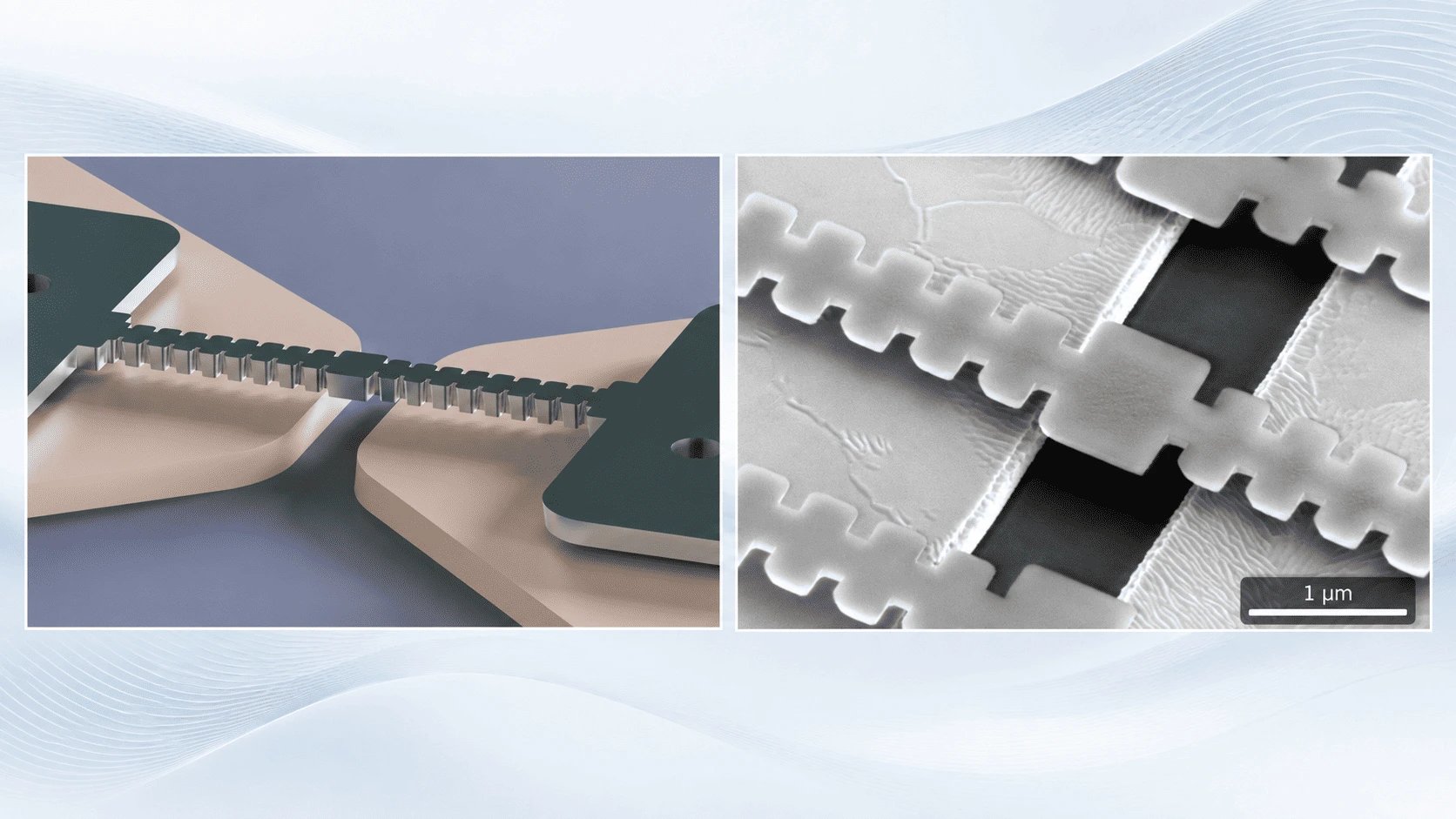
Stanford University physicists directly observed quantum jumps of sound in real time for the first time. The team worked with phonons, the quanta of mechanical vibrations, and observed the moment when the system abruptly transitioned from one energy level to another. Quantum jumps were predicted in the early 20th century and first observed in trapped ions in 1986 and in photons in 2007. Previous experiments with phonons provided only indirect evidence, but individual transitions in real time had not been recorded until now. The researchers created a microscopic mechanical resonator, analogous to a tiny tuning fork, using chip manufacturing methods.
Observation Method
The resonator's key feature was a long vibration decay time of about 2 milliseconds. During this interval, the researchers performed hundreds of measurements to determine the moment when the phonon energy transitioned from level 1 to level 0. The resonator was connected to a superconducting qubit that acted as a sensor and repeatedly checked the system's state without destroying it at each measurement. Amir Safavi-Naeini, the research leader, said: 'We saw that vibrating objects are capable of demonstrating quantum behavior. This is a necessary condition for many operations in quantum computing and sensors.'
Potential Applications
One possible application is error correction in quantum computers, where quantum states are unstable and transitions between levels can represent errors. The ability to track such changes in real time creates a foundation for systems based on mechanical resonators, though the current experiment is fundamental research rather than a ready-made error correction method. Another direction is ultra-sensitive sensors: the Stanford team, together with scientists from the California Institute of Technology, is already exploring the use of the resonator-qubit pair to detect and identify proteins inside cells. The authors also allow for applications in electronics, as mechanical vibrations are used in smartphones and other devices, and more precise control could enable new acoustic components.
1 source
Time · lag behind first