
Swinburne astronomers detect evidence of vacuum birefringence around magnetar 1E 1547
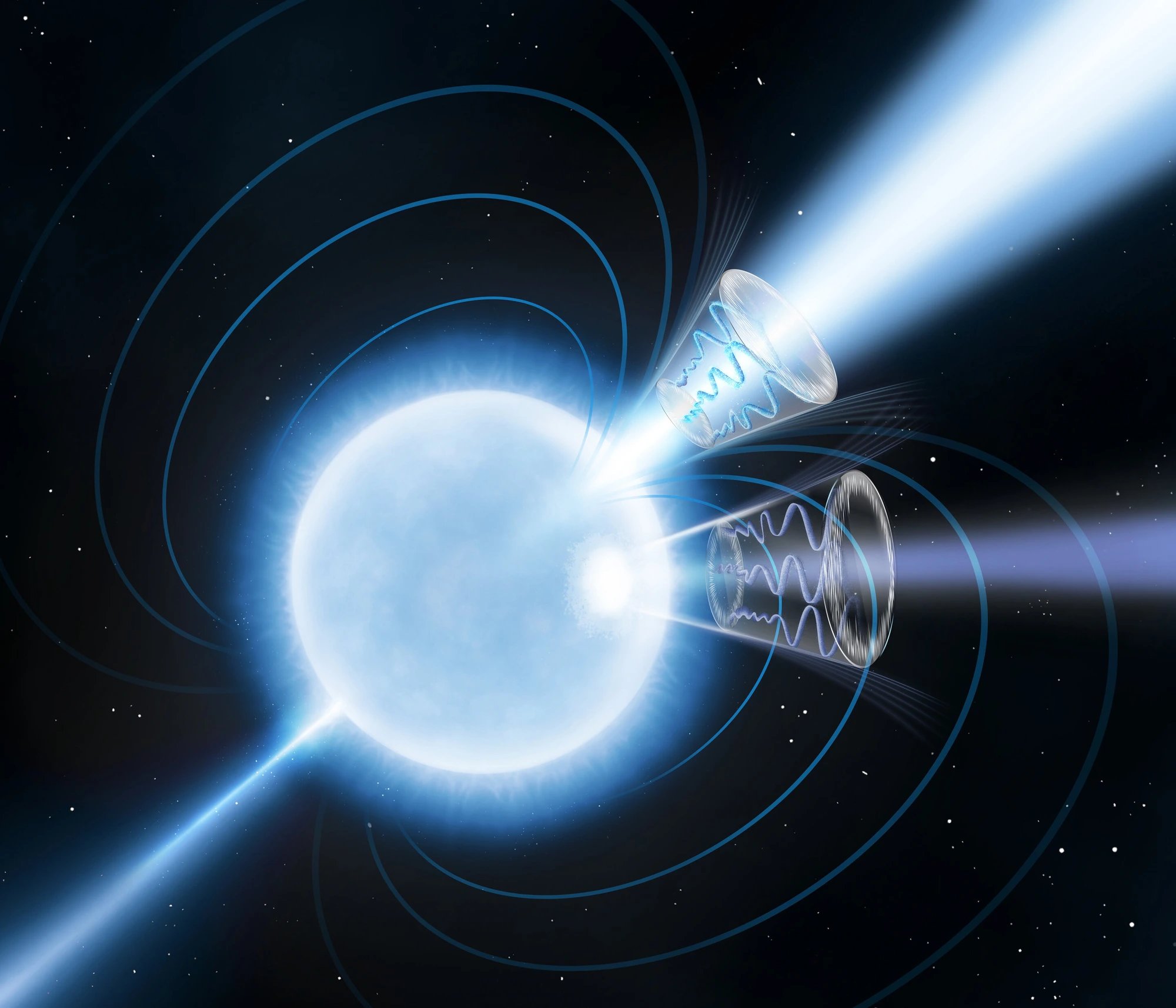
This digest was compiled by AI from multiple sources — links to the originals are below.
An international team led by Swinburne University of Technology detects signs of vacuum birefringence around the magnetar 1E 1547.0-5408, researchers report August 5 in Nature. If confirmed, it would be the first direct observation of this quantum effect.
Magnetar 1E 1547
1E 1547.0-5408 is a magnetar, a rare neutron star with magnetic fields over 100 million times stronger than any created on Earth. Such fields are required to produce vacuum birefringence, where virtual particles in empty space affect light polarization. The team, including Swinburne astronomer Dr Marcus Lower, observed the magnetar using NASA’s IXPE, NICER telescope on the ISS, and CSIRO’s Parkes radio telescope Murriyang.
Signs of Vacuum Birefringence
Observations revealed that both radio and X-ray emissions from 1E 1547 were highly polarized, with polarization directions locked to the magnetic field. This alignment and extreme X-ray polarization are telltale signs of vacuum birefringence. The magnetar’s nearly aligned magnetic and rotational axes, viewed pole-on, made it ideal for detecting the effect. The findings, published August 5 in Nature, could represent the first direct detection of vacuum birefringence.
90-Year-Old Prediction
Werner Heisenberg predicted vacuum birefringence in the 1930s, stemming from quantum electrodynamics, suggesting that perfect vacuums teem with virtual particles. Despite decades of searching, the effect had remained unobserved. Dr Lower stated that detecting it requires magnetic fields unachievable on Earth, making magnetars unique cosmic laboratories. Analysis using Swinburne’s Ngarrgu Tindebeek supercomputer may confirm the long-sought quantum phenomenon.
1 source
Time · lag behind first