
Nature Study Reveals Perpendicular Polarization Switching in Layered Ferroelectrics
This digest was compiled by AI from multiple sources — links to the originals are below.
Researchers discover a mechanism for perpendicular switching of ferroelectric polarization in the layered material Bi₄Ti₃O₁₂. The findings, reported in Nature, show that an out-of-plane electric field can deterministically switch a large in-plane polarization of about 50 μC cm⁻². The cross-coupling opens new routes for capacitive computing and non-volatile memory devices.
The Discovery
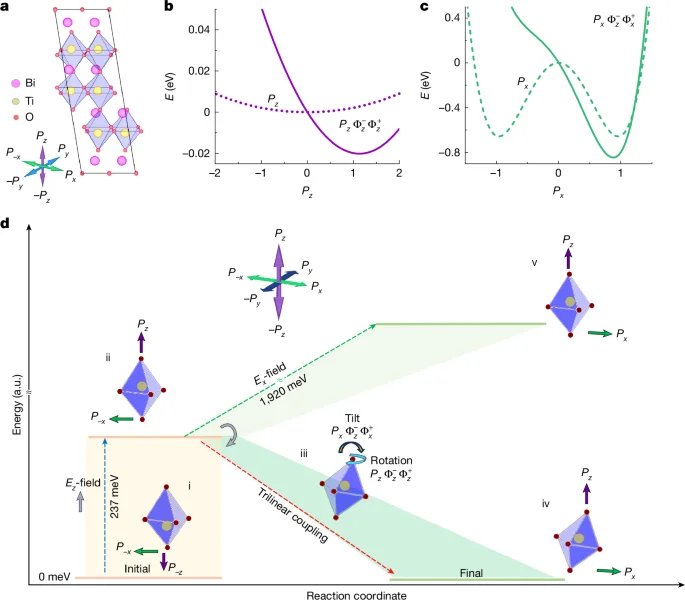
Researchers studied the layered ferroelectric Bi₄Ti₃O₁₂, a material with a monoclinic phase that hosts both in-plane and out-of-plane polarization. In its bulk form, the in-plane polarization measures about 50 μC cm⁻², driven by a proper ferroelectric instability, while the out-of-plane polarization is only about 5 μC cm⁻² and arises from oxygen octahedral distortions. By growing c-axis-oriented epitaxial films, the team observed that the in-plane polarization switches deterministically under an out-of-plane electric field.
Coupling Mechanism
The perpendicular switching is enabled by a trilinear coupling between the in-plane and out-of-plane polarization, mediated by octahedral tilts and rotations. This cross-coupling links orthogonal polarization components, allowing an out-of-plane field to manipulate the in-plane state. The effect circumvents a major limitation of conventional ferroelectrics, where polarization typically aligns with the direction of the applied field.
Device Implications
The discovery could simplify device architectures that require manipulation of in-plane polarization, such as ferroelectric memories and capacitive computing elements. Standard device geometries favor out-of-plane switching, and this cross-coupling brings in-plane ferroelectrics into compatibility. The researchers suggest that layered ferroelectrics could serve as a platform for non-volatile memory and logic applications.
2 sources
Time · lag behind first